Nvoltaic is the production of electrical energy via graphene micro-vibrations of nanomaterial, which produces a physical principle of EMF. (Electric Motive Force). When the wave of graphene touches the layers of silicon, it releases electrons, which causes an electric current. The graphene is used to generate electric current. The EMF that arises in each layer of graphene causes electrons to flow in one direction, i.e., an electric current occurs. The movement of electrons in one direction, electric current in only one direction, i.e., a thin-film diode effect occurs. We are able to increase the output current and voltage with our multilayer integrated technology.
Nvoltaic is based on the use of graphene multilayer nanomaterial (monoatomic layer of graphite) and doped silicon, which converts the energy of the surrounding fields of invisible spectrum radiation, including kinetic invisible energy particles. The graphene has a very high thermal conductivity, which, combined with its high electrical conductivity, allows the passage of an electric current that is a million times higher than the maximum possible current in copper films.
A Nvoltaic power cell is created when the innovative nano-material is placed one above the other, connected in series. By varying the connection of several power cells, a direct current source is created. The Nvoltaic technology has been demonstrated to work in laboratory settings.
The Nvoltaic renewable technology solutions can be jointly developed and integrated into various power-required applications. The advanced energy storage renewable power technology is designed to provide 100% on-demand power and will generate electricity without external input power.
Power cell output power increase as the 22-layer G-Si stack increases. This is similar to a 30 layer micro-chip design.
Power Output Configurations Examples;
- 45 > 22-layer G–Si stack will produce 1.5 Kw
- 90 > 22-layer G–Si stack will produce 3 Kw
- 135 > 22-layer G–Si stack will produce 4.5 Kw
- 180 > 22-layer G–Si stack will produce 6 Kw
- 225 > 22-layer G–Si stack will produce 7.5 Kw
- 270 > 22-layer G–Si stack will produce 9 Kw
- 315 > 22-layer G–Si stack will produce 10.5 Kw
- 630 > 22-layer G–Si stack will produce 21 Kw
- 1260 > 22-layer G–Si stack will produce 42 Kw
- 5040 > 22-layer G–Si stack will produce 168 Kw
- 10080 > 22-layer G–Si stack will produce 336 Kw
- 20160 > 22-layer G–Si stack will produce 672 Kw
- 40320 > 22-layer G–Si stack will produce 1.3Mw
Standard Size Nvoltaic Power System Specs;
- Power Production: 6 – 7 kW
- Internal consumption: 1-2 kW
- Power output: 5- 6 kW
- Annually Production: 43,800 kWh
- Available voltages: AC 380 V – AC 220 V
- Dimensions: 31.5 x 15.8 x 23.7 inch
- Expected Life Span: 15yrs – 20yrs
- Weight: 111 lbs
Customized Commercial Industrial Example Below
Nvoltaic 24/12Kw Power Cell Converters Configuration (264Kw)
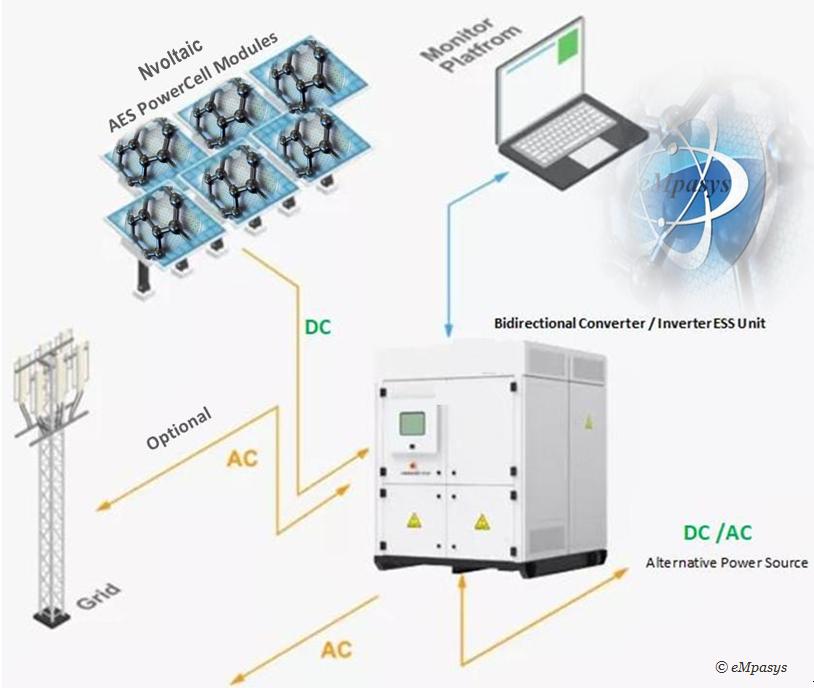
There is a difference between the terms “alternative energy” and “renewable energy.” Alternative energy refers to any form of energy that is an alternative to traditional fossil fuels, like oil, natural gas, and coal. Renewable and clean energy, on the other hand, refers to forms of energy that are renewed by mechanical or natural processes, such as magnetic wave energy, cosmic energy, solar energy, wind energy, hydropower, and kinetic energy.
Request Information:
Your message has been sent

 eMpasys Nvoltaic